Curriculum Intent
In order to develop our curriculum, we have considered the key characteristics of children within Moorside Primary Academy: there are high levels of under resourced families and SEND. We are a smaller than average Primary Academy part of the Advance Learning Partnership family of schools. Our catchment is diverse in the sense we have children from a range of cultures including Poland and Albania but children rarely venture beyond their immediate village. This means they do not have the life experiences of other children to support their understanding of the wider world. We have therefore plotted enrichment opportunities, visits and visitors across the curriculum. We have used the Little People Big World books plotted across the curriculum to develop children’s knowledge and understanding of diversity. We access Durham Learning Resources to support hands on experience of resources though their resource box loans and these have also been plotted across the curriculum.
Children enter our school with development which is below that of children typical for their age with deficits in communication and language and physical development. Our curriculum development has focused on communication and language and physical development together with developing basic skills, vocabulary and a sense of the wider world.
We recognise that reading and basic skills are key to academic success and as such this is priortised in school together with curriculum elements which support our children’s weaker areas of development e.g. PE, Art, Design and Technology and music to target fine and gross motor skills together with manual dexterity. We try to instill in our children that education is the key to becoming a successful adult. Our curriculum reflects our local context and the impact of this context on the lives of our children.
Personal development is woven through our curriculum through our core aims for children:
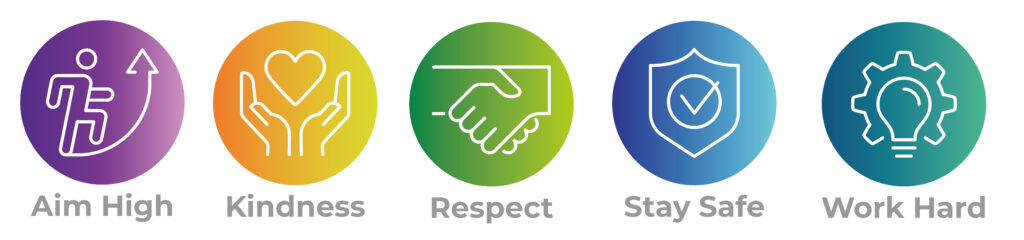
These values form the threads of our curriculum. It is constructed to give children the core knowledge they need to ensure they leave us as well-rounded individuals, ready to take the next steps in their school career with confidence.
Our whole school rewards system is built around children reflecting these values in all aspects of their school life.
We place great emphasis on inclusion and accelerating the progress for all children regardless of their starting points. Inclusion is developed through quality first teaching within classrooms and where appropriate targeted interventions linked to individual support plans.
We have used the key components of the EYFS framework and National Curriculum to plot our curriculum objectives, key learning and progression within this and operate a progressive curriculum within the context of these documents. Subject Leaders have been responsible for developing the intent of their individual subjects linked to our whole school aims, values and priorities. They have developed long-term plans, progression documents and unit overviews to support staff and identified key vocabulary. Where appropriate they have adapted purchased schemes as starting points. Where it is appropriate links have been made between subjects to support children’s understanding. As a small primary school we have constructed a curriculum that runs on a two year cycle (Cycle A and Cycle B).
It should be noted that progression documents are there to act as a guide to staff and it is not expected children will move through them in a linear fashion as all children are individuals. The progression documents are aimed to support with adaptive teaching in mixed age classes, however, it should be noted teacher knowledge is key to meeting the needs of the individual children within the classroom. The focus of adaptive teaching is looking at the stage of a child’s development rather than their chronological age therefore within classroom there may be children working across many aspects of the progression documents for individual subjects as work is adapted to meet their needs through curriculum adaptations and quality first teaching.
As a school in an area of high disadvantage, ‘closing the vocabulary gap’ is important to us. Our curriculum has been designed and suggested key vocabulary identified for each subject. This is progressive across all year groups, so children’s understanding of subject specific vocabulary is directly taught then revisited and built upon year after year. This vocabulary has been identified from the National Curriculum Programmes of Study.
We have three core themes that repeat annually in each year group: family, community and the wider world with a fundraising event linked to one of these. We hope by threading these three core themes as project outcomes through our curriculum, we support the development of British values and develop our core aims of respect and responsibility. Throughout school, developing children’s experiences of the wider world and beyond their immediate surroundings is threaded through the curriculum with key visits identified termly. These experiences include a core offer of at least one visit to an art gallery and museum in each Key Stage. We ensure children experience residential visits at Key Stage 2. We also encourage staff to use visitors to develop children’s core skills and knowledge, whether this be a local shopkeeper, fire fighter or someone with specialist skills in a key area.


